The Attack Resumes
|
At 7:00am, with Kuhn’s changes now in place, the attack resumed. Although improvements had been made, many of the same problems from the previous day plagued the 79th’s advance. The rolling barrage that was supposed to cover the infantry was once again too fast. With the exception of one brigade of 75mm guns supporting the 313th, which were not nearly powerful enough to cause the necessary damage, the division’s artillery was still stuck on the road meaning that there would be little support for the advancing Americans. Attempts were made to request fire support from the Corps’ big guns to the rear, but slow communications meant that the fire requests would be outdated by the time they reached the artillery, preventing the guns from firing for fear of hitting their own men.[1]
Once again, the terrain that the doughboys found themselves advancing over was horrible. The slope leading up to Montfaucon consisted of roughly of mile of steep ground that almost completely lacked cover. |
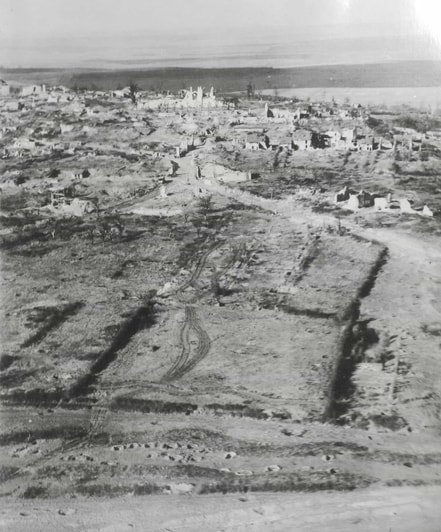
Arial View of Montfaucon (Courtesy of Gene Fax)[link]
|
Not only did this expose the men to the machine guns and grenades of the German defenders, they were also easily visible to the German heavy artillery positioned to their east on the heights of the Meuse River and to the west on the hills of the Argonne, both some 10 kilometers away, allowing the German gunners to hit them with well-aimed and direct enfilading fire. The supporting French tanks thus became easy pickings for the enemy artillery and the infantry, still not having quite learned its lesson about bunching up, were being blown apart in groups of 5-10 by the heavy shells.[2]
The 313th Reaches the Summit
|
When the 313th finally made it up the slope and into the town of Montfaucon itself, a bloody, vengeful struggle ensued. The doughboys moved through the ruins, weeding out hidden German positions with grenades, pistols and knives. Many Germans who surrendered were killed on sight, especially the machine gunners who were shown no mercy.[3] Finally, at 11:55am, the final German strongpoint in the ruins of the town’s church fell (pictured on the introduction page), and Colonel Sweezey, commander of the 313th sent a message to General Kuhn stating the town was taken.
|
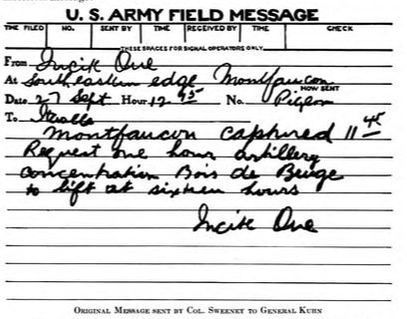
Sweezey's Message (Courtesy of Hathi Trust)[link]
|
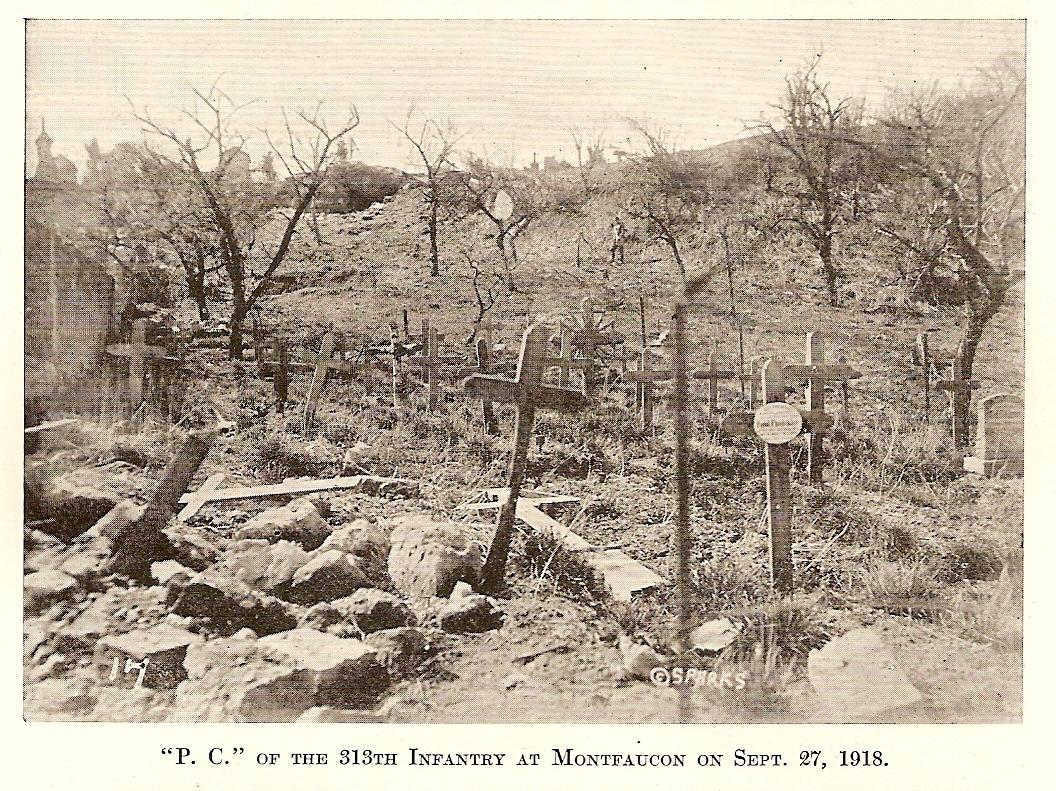
The scene in Montfaucon after its capture was described in the History of Company F:
|
Awful carnage – torn bodies, of the 313th Infantrymen, Germans, and horses, lying in piles amid rubble and wrecked caissons and carts; in the cemetery, coffins and skeletons of German soldiers blown from their graves by the bombardment…[4] |
Citations
Cover Image: Americans Firing from the Ruins of Montfaucon [link]
[1] Fax, 253-254; Lengel, 128; History Committee, 79th Division Association, History of the 79th Division A.E.F. During the World War: 1917-1919, (Lancaster: Steinman & Steinman, 1922), 110. [Hathi Trust Digital Library]
[2] History Committee, 79th Division Association, History of the 79th Division A.E.F. During the World War: 1917-1919, (Lancaster: Steinman & Steinman, 1922), 111. [Hathi Trust Digital Library]; Lengel, 129; Fax, 254.
[3] Lengel, 129; Walker, 174.
[4] Quoted in Lengel, 129.
[1] Fax, 253-254; Lengel, 128; History Committee, 79th Division Association, History of the 79th Division A.E.F. During the World War: 1917-1919, (Lancaster: Steinman & Steinman, 1922), 110. [Hathi Trust Digital Library]
[2] History Committee, 79th Division Association, History of the 79th Division A.E.F. During the World War: 1917-1919, (Lancaster: Steinman & Steinman, 1922), 111. [Hathi Trust Digital Library]; Lengel, 129; Fax, 254.
[3] Lengel, 129; Walker, 174.
[4] Quoted in Lengel, 129.
