After Little Gibraltar and Withdrawal
|
After taking Montfaucon, the 313th attempted to continue its advance, but its hungry and exhausted troops, who had run out of food due to the supply issues on the roads, were unable to continue the assault. To their east, the 314th had successfully taken the small wood of Bois de la Tuilerie, but it too was prevented from advancing further. That night, the Americans on Montfaucon would endure some of the worst shelling they would ever experience, as German artillery and machine guns had been pre-registered on the town, and the lack of counterbattery fire allowed the Germans to rain shells and bullets down on the hill unmolested.
|
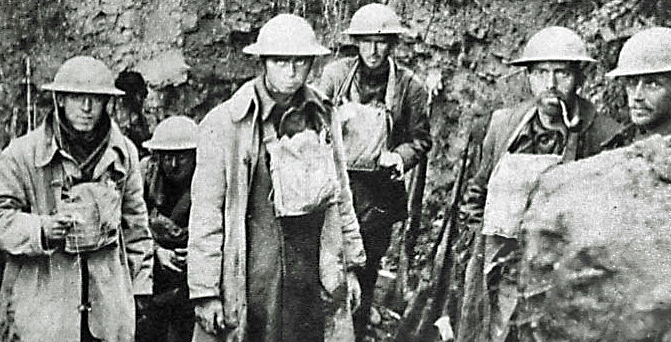
Men of the 314th Showing Signs of Battle Fatigue (Courtesy of Betrayal WWI)[link]
|
The 79th would make a few more limited gains over the next few days, but its attacks on September 29th and 30th would amount to nothing. Finally, with its ranks depleted, men exhausted and supply lines in shambles, the 79th Division would be taken off the line the night of September 30th, 1918.[1]
The 79th in the Press
Back home, the taking of Montfaucon was hailed as a great victory in the press. Numerous newspapers throughout the United States described the speed, cleverness and bravery of the 79th and its advance, but most of these details were positive spins on a much grimmer reality. In reference to the 79th’s failure on September 26th to keep up with its adjacent divisions, the South Bend News-Times of Indiana stated that the “Americans cleverly ‘pocketed’ Montfaucon in their big attack northwest of Verdun today.”[2]* Both The Sun in New York and the Harrisburg Telegraph in Pennsylvania describe the 313th’s lack of artillery support as a result of the speed of their advance, not the disorganized state of the division’s supply lines and dysfunctional communications.[3] This was unsurprising, as the American propaganda machine was in full swing during the war and had proved highly, if not too, effective.**
Citations
[1] Lengel, 130; Fax, 274-329.
[2] South Bend News-Times. (South Bend, Ind.), 27 Sept. 1918. Chronicling America: Historic American Newspapers. Lib. of Congress. <http://chroniclingamerica.loc.gov/lccn/sn87055779/1918-09-27/ed-1/seq-1/>
*The “pocketing” of Montfaucon had actually been part of Pershing’s original plan, as his orders stated that the 4th division on the 79th’s left was to sweep around behind the hill and cut it off from the Germans, but this was misconstrued and not attempt at this was ever made, although one was organized (History Committee, 79th Division Association, History of the 79th Division A.E.F. During the World War: 1917-1919, (Lancaster: Steinman & Steinman, 1922), 479. [Hathi Trust Digital Library]; Fax, 245).
[3] The Sun. (New York [N.Y.]), 28 Sept. 1918. Chronicling America: Historic American Newspapers. Lib. of Congress. <http://chroniclingamerica.loc.gov/lccn/sn83030431/1918-09-28/ed-1/seq-5/>; Harrisburg Telegraph. (Harrisburg, Pa.), 01 Oct. 1918. Chronicling America: Historic American Newspapers. Lib. of Congress. <http://chroniclingamerica.loc.gov/lccn/sn85038411/1918-10-01/ed-1/seq-3/>
**The extreme anti-German sentiment in the US included the banning of the speaking of German in several places and even a lynching of a German immigrant outside of St. Louis. The ringleaders of the lynch mob were acquitted by the jury in around 25 minutes (Fax, 42).
[2] South Bend News-Times. (South Bend, Ind.), 27 Sept. 1918. Chronicling America: Historic American Newspapers. Lib. of Congress. <http://chroniclingamerica.loc.gov/lccn/sn87055779/1918-09-27/ed-1/seq-1/>
*The “pocketing” of Montfaucon had actually been part of Pershing’s original plan, as his orders stated that the 4th division on the 79th’s left was to sweep around behind the hill and cut it off from the Germans, but this was misconstrued and not attempt at this was ever made, although one was organized (History Committee, 79th Division Association, History of the 79th Division A.E.F. During the World War: 1917-1919, (Lancaster: Steinman & Steinman, 1922), 479. [Hathi Trust Digital Library]; Fax, 245).
[3] The Sun. (New York [N.Y.]), 28 Sept. 1918. Chronicling America: Historic American Newspapers. Lib. of Congress. <http://chroniclingamerica.loc.gov/lccn/sn83030431/1918-09-28/ed-1/seq-5/>; Harrisburg Telegraph. (Harrisburg, Pa.), 01 Oct. 1918. Chronicling America: Historic American Newspapers. Lib. of Congress. <http://chroniclingamerica.loc.gov/lccn/sn85038411/1918-10-01/ed-1/seq-3/>
**The extreme anti-German sentiment in the US included the banning of the speaking of German in several places and even a lynching of a German immigrant outside of St. Louis. The ringleaders of the lynch mob were acquitted by the jury in around 25 minutes (Fax, 42).
